Otsikko

Otsikko
Showing posts with label Business models. Show all posts

19 December 2013

Ass laden with gold and other means to conquer new international markets

Philip, Alexander the Great 's father, is said to have remarked that with a gold laden ass one can conquer an invincible castle. Such tactics are not appropriate in today's market conquest, but instead, this post presents some ideas on how a company can make its path to international markets easier.

As a prelude an example of GSM system sales in Germany early 1990s. Initially, our main target was just licensed mobile operator, Mannesmann Mobilfunk or briefly D2 (now Vodafone Germany). Our starting point was not good. As a system supplier, we were very poorly known in Germany, and we did not have anybody in the country to promote our business.
But after all, we had something over there: TV product development, manufacturing and maintenance, PC maintenance, cable machine operations and much more. Some of our German operations were also global market leaders, e.g. in rubber mats for airport luggage carousels. We utilised these assets to build our marketing messages: our local presence, commitment and capabilities to support mobile operators. But we were beaten. That time we did not win the D2 deal. But we learned and gradually built a more solid foothold in Germany - and as a result won very significant deals with Telekom (D1), E-Plus - and also with D2.

In the following paragraphs we take a closer look at where companies can find building blocks to break into new markets.

Other businesses 


A company, which already has an existing business in a new country, should make use of it. Typically, a new business is not known, it lacks credibility, it is not seen trust-worthy and it is missing connections with potential customers and other business-critical players.

An existing country commitment sends a strong signal that also the plans related to the new products are serious and long-term. Secondly, local company infrastructure, such as offices and websites, can be used as stepping stones for building local presence. Thirdly, it is possible to use the relationships and contacts created by the already established businesses and their key personnel to lower the barriers to create new customer relationships and other partnerships. Although in the German example above, we were not immediately able to achieve positive results, credibility and support created by our other German businesses greatly reduced the time to close the first deals.

Local partners


If a company does not have prior operations in a target country, also partners can become helpful. Besides rapid establishment of activities, partners can provide, for example, complementary resources, required local flavour or existing relationships with target customers. For example, we managed to win a GSM system deal with Austrian Federal Telecommunications Authority (ÖPTV) through partnerships with local Kapsch, Schrack, Siemens and Alcatel. The biggest benefit was getting involved in local, slightly political decision mechanism, but the partners contributed some know-how assets and customer understanding, too.

The spectrum of potential partnerships is very broad, ranging from agents and representatives to manufacturing cooperation and mergers and acquisitions. Besides longer term goals, also risk and control are important factors to consider when selecting partnership models. For example, a local distributor or reseller responsible for customer sales minimises risk, because there is no need to invest in offices, distribution, sales force, marketing and customer support. On the other hand, control of the market is reduced: for example, what kind of market activities are conducted and how much customer and market understanding is accumulated. All this limits degrees of freedom in company's future market operations. Greater control generally requires greater own investments - this also makes it possible to better define company's  future aims.

Piggybacking


It is also possible to follow internationally domestic or other established market business partnerships. This is called piggybacking. Typically, customers and distributors are the players that you should look at.

When a principal company expands its operations internationally, its suppliers often have an opportunity - in practise often an obligation - to follow it. Especially in the B2B markets, this is a useful model of internationalisation. It is usually assumed that a supplier will invest enough in new markets. Besides sales and customer support, it may mean building of operations and R&D capabilities. But there is a risk that resources are too much focused on the original client company. This makes it difficult to acquire new customers in the territory and exposes the supplier too dependent on one principal's business fluctuations. Nokia mobile phone business and its subcontractors are an excellent example of this. Nokia pulled for example, Elcoteq, Perlos and Savcor to new markets, where these companies were not able to adequately expand their bridgehead positions.

If distributors, system integrators, retailers and other distribution chain players manage to create on one of the markets healthy and successful business with a company´s products, they have a strong incentive to try to repeat the same in other areas too. Distribution partners may be already present in these new countries or the countries may be for some reason easily accessible for them. If a company does not create own understanding of new market needs and potential, its long term operations and success may be at risk. As an example of distribution cooperation we look at the Spanish system integrator, Omnilogic. Over the years, we had successful cooperation in Spain, where Omnilogic took care of close to all customer contacts and deliveries. Later, the company expanded into Mexico and South American countries, thus opening the markets also for our products.

Other opportunities for international expansion may appear, for example, through technology vendors and financiers.

Digital tools


Digital marketing and sales, as well as compelling content, are a great way to pave the way for the creation of new markets. The key is to create in the target market company awareness among potential customers, their trusted thought leaders and other key stakeholders. Company website, localised for the new markets, is the centre of all action, providing target groups with important and interesting content. The target is to attract visitors to the website by participating in discussions both on traditional and social media.

In many cases, it is also possible to acquire customers through the web. A localised, or even an international online store, together with content marketing, can attract leading-edge customers. These are very important as the company penetrates more deeply into the new markets.

Modern inside selling tools can be used to sell also quite demanding products without a local presence. If, however, the complexity of the product, or other factors require local support, inside sales can assist to successfully pass the first customer decision criteria, thus creating better pre-conditions for the expansion to new countries.

Different business model


Business models that are different from the ones used in established markets are often a good way to penetrate challenging markets. There can be changes for example in monetisation logic, ways to approach customers and company's offering.

Licensing is natural for the companies that own a specific factor that is important for competitiveness. Such factors may be the brand of a product, its design, technology or manufacturing process. Licensing is also a risk-free way to get a new product on the market and customise it to local requirements. A locally established licensee partner gives an end product a local flavour, so licensing is particularly suitable for countries with high entry barriers. The challenge is the legacy that licensing creates, if a company later tries to build deeper market operations.

Franchising is a fast way to build a presence in new countries. Typically, it is used for providing consumer or business services.

Nokia's U.S. market entry utilising Tandy - Radio Shack brand and distribution chain is an example of complying to local requirements in customer interface. In a similar manner, Nokia cooperated with Alcatel and AEG in GSM base station development and marketing to create access to new, previously closed markets, such as France and Great Britain.


Spearheads


Spearhead tactics can build a beachhead in a new country. The goal is to use a selected product or service to create relationships with first customers and then deepen this relationship by selling more. Since the first deal is not yet meant to produce profits, pricing can be aggressive or the product or service can be even provided free of charge. Low-cost experiments, or pilots, are often used to reach the same target. The Internet makes it easy to create free service offerings, whose sole purpose is to market a company and make actual product sales possible.

The last example is from the same country as the first one, Greece. We sold the local Telecommunications Authority, OTE, a cellular network planning and measurement tool. The sale was not as such profitable, but it enabled us to create a client relationship and also awareness of our capabilities in the market. Later, we were rewarded handsomely.

12 December 2013

With a little help from my supplier friends

It is no use to develop only a little bit better product. Just adding new features is seldom the way to build company competitiveness and increase sales. Customer value is created by bringing additional benefits or pleasure. This often requires business model change.

Also Finnish companies have a lot of room for improvement. Too often business growth efforts are product-driven, with only marginal product improvements or changes.

When innovation is customer-centric, there are no more limitations to consider also skills outside the firm. Innovation can be based on building blocks originating from customers, suppliers or academia. This post focuses on the supply partners.

First we shall go through an example in which a company had a strong vision of disrupting an industry and bringing new value to customers. Because the company did not have in-house all the competences needed for the new products, it created various partnerships with technology suppliers. As a final ingredient for success, also a new, innovative business model was created.

Somewhere in California


In November 2000, I spent half a day at PortalPlayer, a company in Silicon Valley to meet their management and experts. The company was small, about 100 people; I came from a large, successful mobile communications company. The core know-how of PortalPlayer were solutions for portable music devices. The solution consisted of a dedicated music microchip, embedded software and a PC application. In addition, the company was able to provide a reference design for customers' own product concepts. In our company we were studying ways to expand our business and music-related products were also under consideration, thanks to the emergence of first MP3 players and Napster.  Although I was impressed by Portal Player´s capabilities, we did not start any cooperation with them nor were capable of developing music related businesses at that time.

Around the same time with my visit, another Silicon Valley company and their CEO envisioned creating and providing new, music-related experiences and solutions to consumers. The name of this company was Apple.

Apple had already made the decision to bring music management software for iMac computers. It was based on the SoundJamMP product, whose developer Apple acquired in July 2000. After some further development it was first launched under the name of iTunes in January 2001. But Apple wanted much more than that. The next step was supposed to be a portable MP3 player. Extremely high requirements were set for the player, with usability and value to the user raised to a whole new level compared to its competitors in the market. It was not important for Apple to design the electronics and the operating system by themselves, so they signed an agreement in early 2001 to use Portal Player reference design as the basis of the new device. iPod was launched in October 2001, and supporting iTunes music store in April 2003. The rest is indeed history.

Back in Finland: Too few ideas and too much risk avoidance


Also Finnish companies need to continuously improve their competiveness by bringing new products to market. Very different types of targets can be pursued. According to an often used breakdown, a company can expect benefits in one or more of the following areas:
  • Improved customer experience and customer engagement
  • More streamlined operations
  • New business or business model
Synergy recently published a research paper, in which it examined innovation capabilities of 50 Finnish companies. All the companies operate internationally and all have significant development activities in Finland. In addition, the results were benchmarked against corresponding international research, consisting of 200 companies. The conclusions were clear: Finnish companies' projects focus too much on marginal improvements and the companies also have a shortage of good ideas. The study has other good observations, but this post is not discussing them further.

Innovation in Finnish firms vs. global benchmarks
When the results are investigated in detail, it is found that Finnish companies avoid risk compared with international counterparts, see also the image on the left. This is reflected in the high proportion of product improvements and modifications as well as additions to existing product lines. Although a better customer experience would be a key objective, probably also lower material and personal costs are important drivers. This is not the way to build competitiveness.

Similarly, compared with the control group, the Finns invest lazily in projects that create new businesses or new, genuine innovations. And since the improvement of customer experience and retention are often outcomes of new business models, many of the companies are thus loosing the potential for higher margins.

Synergy's research also showed that many companies rely too heavily on in-house expertise and resources in generating new product ideas. There is not enough attention to understand customer needs, and the appeal of ideas is not tested with customers early enough. Similarly, if a company culture over-emphasizes technical or product-related know-how, suppliers and partners are easily left with a mere implementer role. As a consequence, new ideas and solutions, which would make it possible to take bolder development moves, are often effectively hidden.

Conclusions


Both the results of studies and the above example show that customer orientation and open-minded cooperation with other companies are the key to a successful business.

The great promise of seeking ideas and solutions from other companies is to have access to the best experts in each of the competence domains. The challenge is to find the right partners and to be able to create a close and trusting relationship with them. In order to partnering be truly useful, a company must be able to build through customer understanding a clear vision of the new brave world that will be available for their customers.

In addition, company processes need to support innovation with others: division of labor between own and other companies´ efforts as well as integration of the outputs. Also, there must be changes, how potential partners are discovered. The key is to keep eyes and ears open for companies that have an offering that could help to implement the targeted customer benefits. Thorough preparation of specifications for external purchasing and strict competitive tendering are well suited only for marginal product improvements and extensions. In some cases such advanced cooperation models as consortia and innovation communities might prove to be most successful.

And finally, in the development of new business models, supplier partners are - if possible - even more important. Besides ideas and solutions, these might have such kind of knowledge and insights that will help clearing up the previously insurmountable obstacles.

7 November 2013

Marimekko digitally x-rayed

Original collections, brand and marketing that is based on own and partners' shops are traditional strengths of Marimekko. At the same time, a number of consumer brands and retailers are increasingly building their competitive edge on digital tools, the Internet and social media. This post studies how Marimekko have managed to combine these new tools with their business activities. Although some of the analysis methods give only indicative results, the main conclusions are, however, built on a solid base.

Marimekko business 


Marimekko is a Finnish textile and clothing design house with net sales increasing again, after the bottom in 2009. This is caused by international growth, which in turn has eroded the profitability of the company. The numbers of 2013 are rough estimates based on realised results of the three first quarters.


Share of search engine visitors (%)

Digital Marimekko


Number of website visitors is a good yardstick for digital popularity. Most of the Marimekko website visitors are coming from search engines, see the figure on the right. More than half of the searches are Marimekko ones, written right or wrong. Thus, by studying the Marimekko keyword frequency, it is possible to make good enough conclusions about the company's popularity in the Internet world.

Global Google searches of Marimekko
If you look at the global number of Google searches made for Marimekko (see the picture on the left), we can see that the number was at its highest early 2008. After that the search numbers have fallen and the decline is projected (dashed line) to continue. The drop in 2008 is at least partially explained by the global economic crisis. It is to be noted, however, that the revenue growth seems to be driven by the visibility caused by retail expansion, not by Internet publicity (that is becoming more and more important).

The sentiment of Marimekko tweets
There is also room for improvement in how Marimekko use social media: the current effect is mediocre, and the company websites are not promoted enough. The sentiment of company's social network attention can be examined, for example, by means of tweets. There were not a lot of Tweets concerning Marimekko before April 2011. Since then the sentiment has been consistently positive, until since June this year apparently the copy scandal changed the tone much more critical. It seems reasonable to assume that the company, without further publicity problems, will soon be able to normalise the situation.

Engagement of Marimekko website vs. some benchmarks
When Marimekko get consumers to visit their website, they are out there reasonably well, see the picture on the right. Engagement of websites in Finland and in Japan is quite good, compared e.g. with fabrics and women's clothing benchmarks.  This is also confirmed by Hubspot evaluation of the Marimekko website, which gives 76 points out of one hundred possible. The main problems are the lack of regular blogging and partially website optimisation for search engines. Marimekko does not provide an application for smartphones and tablets to access the website conveniently.

In addition, the website has very little text (2.72 % ) relative to HTML code. This slows down page loading, which in turn affects e.g. result positions of Google searches. More broadly, Marimekko seem to have problems with content marketing, the low level of blogging is just a sign of it. Publishing compelling content for customers and thought leaders would help to get coverage on other websites and that would correspondingly feed visits to Marimekko's own website. The graph below highlights the number of inbound links to the company website. The number of links, both to the Finnish site and the international one, has since 2011 grown very slowly. It remains to be seen whether the good performance of 2013 is only the result of negative news.
Inbound links of Marimekko Finnish and Japanese websites

Business by market areas


Marimekko report their business by market areas, see the graph on the right. More detailed information is not available, but the analysis will attempt to go to the country level whenever possible. The numbers of 2013 are estimates.

Own stores


The table below shows the amount of Marimekko stores (own, retailer owned ones and shop-in-shops) by market areas. The revenue figures generally correlate well with the number of stores, especially in North America and Asia-Pacific. In Sweden, the option for online purchasing raised own sales; it remains to be seen, if possible online shop launches in other areas will affect in the same way. 


Marimekko webpages


Origin of Marimekko website visitors
Marimekko have their own websites in Finland, Sweden, the United States, Japan, China and South Korea. Swedish site is in English. In addition, there is an international site in English. The fact that there are no sites with local language available in some major market areas is a serious problem; France, Germany, Spain and Italy are good examples.

Global website ranking of Marimekko

There is no information available about the traffic volumes of the Far East websites. According to Sitetrail, Finland and the United States are leading the visit statistics of the rest of the world, see the picture above. The development of company´s global website ranking is shown in the figure on the left: despite of international expansion, the company ranking has not greatly changed. Finland is by far the most favourable country, Marimekko's rank is currently 615.

Marimekko searches


Google searches of Marimekko in Finland
Development of Google searches in Finland is shown in the adjacent graph. After 2011, there has been on a slight upward trend, surpassing even the sales and store number growth. Dashed line shows the forecast.

Marimekko searches, Sweden and Denmark

In Scandinavian countries, searches are, in turn, been on the decline, see the graph on the right. Interest to make Marimekko searches is thus not following the number of stores or even revenue growth.

The situation in biggest Central and Southern European countries is presented below. The trend is slightly positive in Germany and negative in Italy and Spain. United Kingdom has remained unchanged. In spite of the growing sales, the share of Marimekko´s store sales has been on the decline, which is also reflected in the search statistics. In all countries, the Google one day Marimekko promotion (Google Doodle) in 2012 has created a clear peak.

Google Marimekko searches in Central and Southern Europe
USA and Canada, Marimekko searches

Searches in the United States have roughly remained at the same level, only slight decline this year. In Canada, there is a slight increase. Although the number of stores and company own sales have grown up in a relatively fast pace, this does not appear to have an impact in the search statistics.


Japan and Australia, Marimekko searches
In the Asia-Pacific region, both in Japan and in Australia, business expansion, the opening of new stores and the popularity in the digital space have gone hand in hand. This has resulted in a brisk revenue growth. In Japan, the concern is that during the last couple of years, the trend is downward. There is no information available about China, due to the central role of the Baidu search engine in the market.


Inbound links to Marimekko webpages


Geographical origin of inbound links to Marimekko webpages is illustrated in the map below. At least China does not yet pop up with the weight corresponding to its value in Marimekko's strategy, and also in the United States the relative visibility is quite poor. In contrast, Finland and the rest of North and Central Europe are relatively well represented.

Inbound links to Marimekko webpages

Marimekko in social media


The origin of Marimekko tweets are shown in the map below. The United States and Japan are by far the biggest tweeting countries - the number of tweets in these countries is, however, always large compared to smaller countries. Other notable countries, as regards to Marimekko related tweets, include Finland, Australia, Canada, United Kingdom and Italy. There is a surprisingly weak popularity for example in Sweden, Denmark, Germany, and France.

Marimekko tweets by country

Business by product lines


The company business is divided into three product lines, Clothing, Interior decoration and Bags, see the picture on the right presenting their revenues. The numbers of 2013 are estimates.

Digital footprint and marketing of the product lines can be evaluated using Google search statistics. This is best done by comparing Marimekko related searches with suitable benchmarks.

Marimekko searches vs. women´s clothing ones
Women´s clothing is perhaps the most important segment of the Clothing product line. The trend of Marimekko searches has clearly fallen behind women's clothing category that serves as a benchmark. The thick horizontal line describes the zero-level development of searches  and Marimekko's line is a lighter blue, see the picture on the left. While Marimekko's Clothing sales has recovered slightly after the drop that started in 2008, this does not seem to appear in the digital popularity.

Marimekko searches vs. home-making & interior decor ones
Google searches of home-making and interior decor category are a good benchmark for Marimekko´s Interior decoration product line. Again, Marimekko has fared less well than the benchmark. Also the recent sales growth is not seen in Marimekko searches, compared with the benchmark.

Google Marimekko searches vs. clothing accessory benchmark
Clothing accessories category of Google searches are used to benchmark Marimekko´s Bags product line. The growth of the product line that started in 2010 was first visible also in search statistics, but after that Marimekko has fallen behind their benchmark.

Conclusions


It is clear that Marimekko are not effectively enough using available digital marketing tools alongside product portfolio renewal, expansion of retail and the brand. There is a risk that with changing consumer purchase behaviour, relying more and more on digital channels, Marimekko´s relative competitiveness will suffer.

Marimekko is not visible enough on the Internet. The websites are clearly not interesting enough, and the company messages do not reach other websites. In addition, in many major market areas, there are no company websites available in local languages. In social media, Marimekko is not sufficiently benefiting from word-of-mouth and the company websites are there not promoted enough.

The worrying thing is that Marimekko´s new stores and other major investments in new market areas do not seem to get enough support from digital activities. Although some promising examples can be found, this means inevitably only half-hearted success. All the three product lines seem to have a declining trend in the digital world compared with the benchmarks. 

Besides customer acquisition and retention, digital tools offer a great promise for in-depth identification of customer needs, rapid customer feedback of new products, as well as customer-oriented testing and improvement of marketing plans. Marimekko will face the threat of missing these potential benefits, unless they fully utilise opportunities of the Internet and social media.

31 October 2013

Internet industrially - doping for competitiveness

I got to know industrial automation in the late 1980s, when we developed software and interface modules based on Bitbus distributed control standard to connect sensors and actuators. In mid 1990s, I was leading another company, which created and sold one of the first machine-to-machine (M2M) solutions based on wireless communications. This fuelled the view that this area will generate great business - but, as is often the case, slower than we imagined at the time.

In retrospect, it can be understood why in the 1990s there was no premises for the emergence of major businesses:
  • Availability and use of sensors were limited and the prices were high: for example, our proprietary GPS tracking solution cost hundreds of dollars per unit
  • IP technologies and wireless communications were not yet sufficiently developed: for example, we had to use wireless SMS and a proprietary protocol built on top of it to communicate with smart devices 
  • Data storage and processing methods were immature: our solution was a typical client-server solution with proprietary applications
  • Ability and willingness of firms to use networked solutions for optimising operations was limited: in most cases, solutions were customised, and thus it was not possible to scale business
The situation is radically changing. The Internet and other new technologies open up a world of new business opportunities. This post outlines the opportunities from manufacturing industry point of view, focusing on companies´ product sales and customer relationships. Benefits, relating to e.g. company's own internal decision-making or improvement of internal efficiency, are not discussed here in detail.

Manufacturing industries meet the Internet


The physical world is becoming an information system. This change is referred to as the Internet of Things (IoT), sensor revolution or programmed world, among others. GE calls it the Industrial Internet. Regardless of the naming, sensors and actuators embedded in physical objects - from roadways to pacemakers - are linked through wired and wireless networks, which often (but not always) use the same Internet Protocol (IP) as the Internet. Vast amounts of data are sent through these networks to computers for analysis and the results are further submitted to users in an easily readable format.

There are number of factors driving the development, such as:
  • Availability of various types of sensors, growth of sensor use and sharply declining prices, caused by e.g. consumer product volumes and advances in material technologies
  • Development and standardisation of wireless communications technologies, such as 3G, WiFi, BT Smart and RFID
  • Development of Big Data storage and analysis technologies, especially driven by needs of consumer Internet services
  • Companies with strong interest in business model development and operations optimisation, based on realised benefits derived from the use of Internet tools
The core of the IoT is to use analytics for process automation, performance optimisation and downtime elimination, as well as to predict when a machine or component will fail. For industrial companies, this may indicate a threat or an opportunity. The threat is that the value of products will migrate to software, provided by other companies, thus endangering profitability of traditional product companies. A more sensible approach is to see the opportunities; in parallel with securing current product business, new value adding Industrial Internet offerings need to be developed.

The Industrial Internet is expected to see tremendous growth. Wikibon says that last year $ 20 billion were used in IoT technologies and the forecast for 2020 is $ 514 billion. Similarly, the Industrial Internet generated last year value of $ 23 billion, and in 2020 it is projected to reach $ 1279 billion. Looking this from another perspective, the Internet today is connected to a little more than 10 billion units. By 2020, the figure is 30 to 75 billion, depending on who is the predictor. The IoT is the biggest growth driver.

Regardless of whether above projections will be realised or not, huge business opportunities will be opening up. The key is to use existing and potential customer relationships and to create new solutions that are exploiting the Industrial Internet. This will also build competitive barriers against cheap equipment suppliers and create opportunities to maintain and further develop company's manufacturing competitiveness.

Business models for the Industrial Internet


To realise the potential of the IoT requires, besides new technology skills, also new business skills related to the Internet and its business models. This section first discusses various options for company business development and then presents four models of how the Industrial Internet can be used by a manufacturing company.

Development options


In principle, a company can develop both technical and business aspects of Industrial Internet solutions in-house, only recruiting necessary additional skills, if needed. Possible challenges here are the old models of thinking and the legacy in building new competences - the company makes too little and too late. Often used solution is to establish internal incubators, organised separate from day-to-day businesses. The incubators are able to develop and test new ideas before they are transferred to the responsibility of mainstream businesses. For example, Bosch has set up three innovation clusters: connected mobility, connected energy and connected building.

Capability building together with partners is a very viable option. Partners may be universities, research institutes and other companies. Especially with the latter, there are many models where traditional rivalry may in some areas be complemented with tight collaboration.

Mobile operators that are very active in the M2M space as solution providers, are natural partners among larger companies. Other prominent players include such companies as Cisco and Ericsson in communications, Intel in micro chips as well as IBM in software and services. Correspondingly, also the big Industrial Internet players are seeking cooperation. GE has made a substantial investment in EMC / VMware spin-off, Pivotal, a company that builds Big Data solutions. In the same area, GE has also announced collaboration with Amazon.

As in the development of the Internet in the past 20 years, startups are going to be a very important source of new ideas and innovation. Cooperation with startups can be anything from using their solutions to acquiring a startup. In this area too, GE has been very active by setting up a base in Silicon Valley and by kicking off a number of cooperation activities with startups.

There are plenty of startups working with sensors, Big Data and M2M, just to name a few. Besides sensor technologies and solutions, startups are also launching solutions to gather and aggregate sensor generated data. Storage, analysis and presentation of Big Data has spawned a number of new entrepreneurs. The traditional model of M2M startups has been seeking cooperation with mobile operators, but also other models are already being introduced in the market.

Improving product competitiveness


Improving competitiveness of a company´s products by increasing their life cycle revenues or by reducing their life cycle costs is probably the most common way to take advantage of the Industrial Internet. For customers this is realised through various value-adding services that are either a core part to utilise the product or supporting the product very strongly in some other way.

A good example is GE that embeds smart sensors in the jet engines and takes advantage of terabytes of data generated to optimise aircraft performance and the ways the engines are maintained. Konecranes TRUCONNECT services, on the other hand, contribute to crane safety, optimise maintenance costs and predict the needs of modernisation. An finally, Vesta support services assist customers to define optimal locations for windmills.

New business


It is also possible to build a completely new, independent business. Typical products are consisting of software that solve specific customer problems. Software may be able to control only the equipment provided by the firm, but it is often advantageous to create interfaces to other vendors´ products, too. In particular, for start-ups and businesses that account for only relatively small part of customer's installed base, this is often the only sensible strategy.

Bosch software products promise to integrate equipment with customers' business processes - equipment can be sourced from numerous manufacturers. The software can also be connected to various back-end systems from multiple vendors. GE has developed an application for power companies, which can be used to determine how to best build and operate turbines. Same kind of software are being developed for rail, mining, oil and gas companies.

New business model


Benefits of new business models - if successful - may be significant. The challenge of reaping the most dramatic benefits is that the development of new value chains requires key players´ support and it takes time to build these chains.

Real-time data generated by sensors, combined with historical data, makes it possible to analyse and predict with high precision use of equipment and machinery. This paves way for new business models, where manufacturers are charging for their products based on costs, revenues or time, whereas the conventional model relies on equipment or machinery purchase and maintenance.

Another example uses crowdsourcing to create added value for company's products. Ford is utilising open interfaces and allows in its OpenXC initiative to customise car features with add-on modules and applications. GE also relies on individual and startup innovation and value creation, and has launched measures to develop solutions for tackling air traffic delays and efficiency of hospital visits.

Marketing assistance


Although it would not be possible to create value-added products, totally new businesses or new business models, the Industrial Internet can significantly boost company's marketing and sales efforts. The main idea is to provide customers and other important stakeholders useful and interesting information, which will improve the competitive position of company's products. The key stakeholders are traditional and digital media, channel partners and influencers important to customers. In this context, the key source of information is the data generated by the products of the company or other data that the company can access at a reasonable cost.

Also the companies that sell to business customers cannot forget opinions of media and consumers: if corporate citizenship is not communicated properly, it will be quickly heard by customers´ decision-makers. If a company sells its products through channel partners, the partners will appreciate any information that helps them acquire new customers or any new opportunities to sell customers new services. Both for media and for customer advocates, it is important to get new information and insights that will enable them to further build their authority in the topic area. Well-thought, fact-based opinions based on available data are a great way to engage customers through media and advocates and thus support sales of company´s products.

For example, a car manufacturer could embed one more sensor to its cars: air pollution sensor would give a car user air quality information from those places that are important to him and give everyone an overview of air pollution situation. When used properly, this kind of activities can provide very interesting information for consumers and also for media, which creates good opportunities to highlight company's social responsibility. Cisco is strongly involved in even more ambitious project. Planetary Skin tends to use billions of sensors on land, water and in the air to detect and predict changes in the environment.

23 October 2013

Quo vadis, Sports Tracker ?

Sports Tracker application is like an old friend. I have used the fitness application from the time it came to market in 2005. I have no closer relationship with Sports Tracking Technologies, the company that is currently responsible for the business.

I was amazed when I read that a Sports Tracker competitor, Endomondo application (which I have also used), is used five times more when counting sport use kilometers. This aroused my curiosity. Are Sports Tracker really trailing Endomondo so badly? What factors have contributed to the development? What is Sports Tracker´s future and how could they improve the business? I did a little bit detective work. By using only public and free sources and tools, the picture became considerably clearer. This research trip is also a good example of how companies can analyse businesses and competitive situation, and thus develop more successful strategies.

Sports Tracker vs. Endomondo


Sports Tracking Technologies (hereinafter referred to simply as Sports Tracker) are a Finnish company with Nokia Corp. roots. A Nokia project launched the first version of the fitness application in May 2005. Endomondo are a good benchmark, because they are coming from another small European country, Denmark, where they were founded in November 2007. Apart from these two, a number of other competitors have emerged, such as Nomad, Skimble, Strava and Runtastic. They are not discussed in detail here.

Number of users


The Sports Tracker application has been used for 230 million sports kilometers, and the Endomondo one for about 1600 million. Various sports kilometers do not match, so this does not clarify the situation. If the number of users would be available that would help a lot. But only Endomondo have published the information that they have cumulatively 20 million registered users. AppAnnie give estimates on application downloads and they provide, inter alia, the following information:
  • In Apple App Store´s health and wellness category the free Endomondo application was in top five in eight countries and in top ten in 23 countries
  • Correspondingly, Sports Tracker were in top five in three countries and in top ten in 13 countries
  • In Google Play´s health and wellness category Sports Tracker were in top five in two countries (Endomondo in eight) and in top ten in six countries (Endomondo in eighteen)
Although AppAnnie do not evaluate Sports Tracker´s traditional area of ​​strength, Symbian, currently Endomondo seem to have a clear lead in download volumes.

Product features


We shall not make any product reviews or comparisons, they are already readily available from multiple sources. Instead, we shall first focus on expert views that are affecting potential customers and also on how users are seeing the two companies´ products.

In various expert reviews Endomondo would appear to get generally higher marks than Sports Tracker. The former have an extensive feature set and well-functioning web services, the latter have a praised mobile application. Sentiment analysis of user tweets is one way of measuring user perceptions, see also the picture below. Product usage experiences are likely to be the most important factor affecting the sentiment of messages. The companies´ products seems on a par till autumn 2011, after which Endomondo reputation is a little bit better.


Characteristics of company products do not explain differences in popularity, so we need to have a look at the reach of potential customers. The most important factor affecting it is the range of operating systems supported. Sports Tracker support extends to the following: Symbian, iOS (Apple), Android, and MeeGo (Nokia N9). Endomondo again support all the previous except Meego, plus they support also RIM (Blackberry). In addition, it is important to understand when the most important operating systems got the support, see the picture below. The picture also shows smartphone sales per Symbian, iOS and Android.


It is clear that Sports Tracker were too long stuck with Nokia and Symbian, and as a consequence, came too late on the tremendously crucial iOS and Android markets. It is difficult to assess whether this was due to not understanding the markets, long-standing links with Nokia, lack of resources or something else.

Marketing


Use of the Internet and social media have certainly been the key of both companies´ marketing efforts.

Google search statistics dramatically reveal how Sports Tracker have not been able to improve after the year 2009. Endomondo overtook them in the beginning of 2011 and have since then continuously been able to increase their attractiveness. The picture on the left shows also projected searches with dashed line. The number of searches correlates well with overall marketing efficiency and thereby also with interest in company's products.

Web service is an essential part of the overall service offering as perceived by a user. Company website is also an important part of digital marketing assets. Hubspot tool gives Sports Tracker website a score of 54 (scale 0 - 100) and Endomondo get a much better grade of 81. The main problems of Sports Tracker are blogging, mobile use of the website, lead generation and optimising pages for search engines.


Endomondo also have a clear advantage when measuring website visits, see the pictures on the left, Endomondo at the bottom. The pictures illustrate companies´ global ranking of website visits. Again, the Endomondo trend is positive, whereas the Sports Tracker position has not really improved over the years.

Popularity of company's websites is also greatly affected by the number of incoming links. The picture below shows that till the summer of 2011, the companies were equal; but after that, especially since summer 2012, Endomondo have improved much more. This can be partly explained by product features and partly by website attractiveness and success in content marketing.


Problems with Sports Tracker website content become also visible when looking at search results (SERP) of keywords that are important for fitness applications. The two companies occupy the top positions when searching the respective company names with Google. But for example, when searching  'GPS sports tracker', Sports Tracker occupy only the position 3, whereas Endomondo get positions 2, 4, and 5.  'Social Sports Computer' is the central Sports Tracker website tag line, but the positions are not better than 5 and 6.

The most worrying thing is that even when Sports Tracker are able to attract visitors to its website, these visitors do not find the pages interesting enough, see the Alexa picture below.


More than half of the visitors only visit one page, and others do not find a lot of compelling content.

Also in social media utilisation, Endomondo seem to be more skillful. For example, already in 2010 they were more popular than Sports Tracker in Twitter messages, and after that differences are even more remarkable, see the picture below. As regards to Twitter followers, the two companies are almost on a par: Sports Tracker are followed by almost 18000 and Endomondo by almost 21000 persons. This indicates that Sports Tracker still have, however, loyal core group of followers, which are constantly interested in their products.


Business Model


Product development and marketing are of course closely linked to the resources available. Resource availability, on the other hand, is greatly affected by the business model and especially revenue streams.

After Nokia years, Sports Tracker became an independent company in May 2009. The company's turnover in 2012 was 702 000 euros, it was making heavy losses and the equity was negative. The fitness application is downloadable free of charge, and there are no fees related to usage of supporting web service. The company seem to be receiving their income by selling heart rate measurement belts, iPhone bike mounting accessories, headware and socks. Long Nokia connection seems to have affected on the company mindset and implemented business models - when the company was a part of Nokia, the role of their service offering was mainly to support primary equipment business.

Endomondo have been able to take advantage of the emerging business opportunities. When Apple launched App Store in July 2008, and Google store opened in September 2008, they were able to rapidly grow their user base. Alongside the free application, a paid PRO version was launched in December 2010. App Store made it possible to make in-app purchases, i.e. to buy extra features for free apps, in August 2009, and Google Play store started to offer the same option in February 2011. Endomondo began to take advantage of these opportunities in 2011. The company also began to show advertising in connection with its applications and website services in September 2012. In addition, the company have partnered with another company to sell a variety of sports-related products. Endomondo revenues are already sufficient to cover operational costs.

Financing


In order to build operations and products as well as to acquire users, both companies have needed to seek external funding.

Sports Tracker financing was handled by Nokia for a long time, but after the establishment of the new company, they have been funded at least by Nokia-Technopolis Innovation Mill, Tekes and the City of Helsinki. Amounts of money have not been published.

Endomondo have received undisclosed amount of seed funding in December 2010, $ 800,000 in March 2011 and $ 2.3 million in September 2011. The company claim that they do not need any external money to continue operations.

It is noteworthy that Endomondo´s external funding has always been linked with company's reported product improvements, measurable improvements of market position and business model enhancements - see also the facts presented earlier. There is no detailed information available about Sports Tracker´s financing projects, but the presented facts tend to imply that attracting new money is much more challenging than in the case of their competitor.

Conclusions


Sports Tracker seem to have a lot of work to further develop their product and marketing as well as to improve the business model. It is most likely that unless the company is able to get external funding, it is not possible to make sufficient investments.

There are, however, substantial and growing markets for the company's expertise and products: fitness and well-being are increasingly important future trends. And the markets have certainly not been shared, yet. According to Alexa statistics, both Sports Tracker (below left) and Endomondo (right) site visits are dominated by small or medium-sized markets; it is still possible to significantly change competitive positions both on current target markets and on many of the biggest markets, not deeply penetrated today.


It is vital, however, that Sports Tracker are able to find again an agile way-of-working, where new emerging business opportunities are boldly and rapidly utilised. This will create constantly renewing competitive advantages upon which to build a successful business.

2 October 2013

5 models for Big Data business success

Can data be used to create growth? At least Ronald Reagan believed so, when he said that information is the modern world oxygen. Information has, of course, always been important in business, but the Big Data phenomenon is forcing companies to think more about how they could use information to drive their business.

Big Data and company competitiveness


Gartner defines: Big Data are high-volume, high-velocity and high-variety information assets that demand cost-effective, innovative forms of information processing for enhanced insight and decision making. Big Data's core is therefore not the data nor its high volume, but the company's innovative way of using various sources of available information for successful business building. More and more enterprises are already operating this way: a recent survey found out that 80 % of companies see that harnessing data would make their business stronger.

From a company point of view, sources of data can be divided into three, partly overlapping categories:
  • Firm internal data or the one available through business operations: for example, customer click data at company web pages, data collected by customer services or data provided by equipment and systems delivered by the firm.
  • Data obtained from other companies or entities, in most cases paid data: for example, aggregated data related to potential customers or machine use -related or environmental data provided by firms generating or aggregating them.
  • Public data: Data that has been made available by government, often free-of-charge, for example, various public records, weather and map data.
Data volumes are not large, they are huge - last year 2.6 zettabytes (10 to the power of 21) of data was created in the world, and that number is expected to grow by 40 % annually.

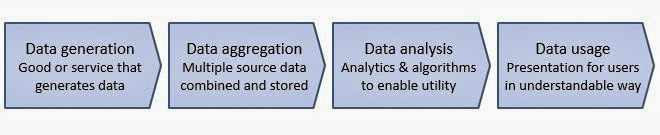
Source of data has a significant impact on businesses. This can be analysed by looking at the simplified value chain of Big Data that consists of four stages, see also the attached picture.


Each stage of the value chain sets different types of requirements to be competitive:
  • Data generation: Opportunity to get access to proprietary data by means of own business; understanding of what is essential in data and how it can be generated.
  • Data aggregation: Understanding of where and how data can be acquired; understanding of how data should be combined and stored so that it can be further processed and made useful.
  • Data analysis: Analytics and algorithm skills; ability to interpret the importance of data from use point of view.
  • Data usage: Ability to present data to users in a readily comprehensible form; understanding of user needs.
Familiar theory that explains how early-stage vertically integrated industries are gradually transforming into specialised ones, ie. horizontally integrated, can also be used in Big Data context. As industry competition is constantly in motion, companies need to shape their own strategy and positioning on the value chain by looking at their competitive advantages and capabilities.

Big data advantages, at their best, reinforce competitiveness of a firm, resulting in profitability and growth. In order to really achieve results with planned activities, Big Data projects need to be anchored in the improvement of competitive position. Assessment of own capabilities gives a realistic picture of what value chain positions are sustainable in a long run. Because overall business benefits are the most important ones, it is feasible to outsource the stages, where competitive advantages cannot be defended.

Big Data growth engine


This section deals with development of Big Data business models and especially ways to achieve growth. Big Data strategic benefits, such as ability to make faster, better or more proactive decisions, or efficiency improvement factors, such as improvement of capabilities and processes, are not discussed in detail here.

Independent Business


Independent Big Data based product businesses can be built by established companies or startups.

For established companies, it is convenient to develop new offerings for existing customers or take advantage of the data that the ongoing activities are generating. In the first case, understanding of customer needs and good customer relationships are typically key competitive advantages. In the latter, preferential access to data gives differentiation. For example, McKenney, a mechanical contractor of buildings, developed a service to reduce maintenance costs by collecting actual building data over the years. If a company position in customer interface or in data collection is strong enough, it is possible to partner with other players to complement the value chain.

Startups are usually missing most of the established companies' competitive advantages and resources in utilisation of Big Data, so they have been more active in the development of tools and know-how. There are many areas, however, where new, disruptive business models have been created, such as job search and recruitment firm Bright, Climate Corporation in crop insurance or Ambiohealth in remote health. Acquiring a startup can offer an established firm a head start to create a new business.

Improved access to public data has reduced the barriers that startups and other actors are facing when bringing new services to markets. For all have access to the same information, successful companies need to continuously improve user experience or add new data sources to stay competitive.

Sales of tools and know-how


In particular startups are actively developing new tools and know-how, in order to sell them to other businesses and organisations. These are exemplified by DataSift and Enigma in data aggregation, Cloudera and Cloudant in data storage, Cloud Physics and Gravity in data analysis and Icimo and Platfora in data presentation. Sensinode, recently acquired by ARM, is an example of Finnish Big Data startups, focusing on data collection technologies.

Support to other businesses


Activities that support well-established businesses will be hugely important as sources of business growth. Also startups are important as outsourced innovators of established firms: they are able to develop and test new ideas and when enough traction has been created, an innovation often ends up being part of the purchasing company's activities.

Support activities aim to maintain and improve competitiveness of company´s current business operations. Life cycle cost reduction of company products through proactive maintenance, cost reduction of distribution through route optimisation and customer satisfaction increase by utilising customer data are good examples of that. The key thing is how Big Data affects on overall revenues and expenditures, not costs and potential income of Big Data initiatives as such. GE and Konecranes are great examples of companies investing in so called industrial Internet - it is believed that Big Data strategy differentiates products and brings significant additional income. Amazon and Walmart are prominent firms utilising Big Data for customer relationships.

The core of the data used for support purposes is mostly in-house, but it can complemented, where appropriate, with purchased and public data. For example, weather and traffic data can be used to refine equipment use or website behavioural data.

Data sales


If a company cannot find meaningful ways to use available Big Data in its own business, opportunities to sell the data to other players should be explored.

Companies such as Bloomberg, Experian, and Affecto are already selling their data and also offer views and analyses based on them. These actors, however, are vertically integrated with operations primarily based on their own data. It is expected that new players, who generate or aggregate unstructured data originating from multiple sources, will be given a wealth of new opportunities.

This will provide Big Data generators and aggregators opportunities to sell data with various maturity levels; either to specialised broker firms or to other firms that make use of this data in their own businesses.

Marketing tool


Big data can also serve as a tool to attract customer prospects to become clients of a company. The trick is to provide free or low-priced information that is important and valuable to potential customers. Use of information creates a relationship of trust with the information provider and reduces barriers to buy full-priced products. Earnings impact is generated indirectly, through increasing customer numbers and revenues.

For example, an investment services company could use social media and the Internet to make sentiment analysis of listed companies for anticipating stock price movements and to provide this service free-of-charge for potential customers. Similarly, an equipment manufacturer could create thought leadership in its industry by developing an easy way to track factors that affect on raw material or semi-finished product prices, important for its potential customers.

If the used data are company proprietary, it is usually easier to functionally combine them with the products sold to customers. There are no reasons, however, that would prevent from developing this kind of offering based on acquired data only.