Otsikko

Otsikko
Showing posts with label Commercialization. Show all posts

23 March 2015

Yesterday´s sales methods equal inferior results

If your B2B sales continuously moves brilliantly forward, do not waste your time reading this blog. But at least I, who started my B2B career by selling electronics to various industries and continued with mobile networks, sit constantly at school. Many of the traditional truths, such as importance of customer business and purchasing process understanding, are still valid. But many things have changed and are changing. Customers are looking for information on websites and social media, buyers are becoming better informed than sellers. Sales efficiency is going down, although costs go up.

As a result, a straightforward addition of sales efforts seldom leads to company growth and profitability. Instead of just replicating old way-of-working, you should reconsider your sales methods and reinvent customer acquisition approach - also in the business world, winners take it all. This blog will focus on, in particular, why reducing sales complexity is vital for B2B firms and how this is done in practise. After reading you will have fresh ideas to boost your sales efficiency and tackle new customer segments.

Sales methods


Sales efforts required to get B2B deals vary enormously depending on sold products or services. Tens or even hundreds of selling company persons are involved in the selling process of nuclear power plants, mobile networks or luxury cruisers, the process will take months or years of calendar time and the cost can be easily millions or tens of millions of euros. Some products, again, can be sold online with self-service, without direct involvement of seller.

Sales methods can be roughly divided into three categories, according to new customer acquisition costs (CAC):
  1. Self-service: Customers are attracted to company's web sites, by making use of, for example, search engine marketing and optimisation, content marketing and e-mails. Deals will be closed automatically, seller personnel do not have to participate, because the product is easy to understand and the value for customers is clear. Customer acquisition costs are mainly digital marketing costs, typically 30 to 200 € per new customer.
  2. Inside sales: This model is built on top of the self-service model. Customers are nurtured towards deals by responding to queries and questions by e-mail, telephone and video chats, as well as by showing demos over the network and by using other digital tools. Besides dedicated sales persons, also technical experts may be involved to clarify the details of the product or its use. Typical CAC is 600 to 6000 € per new customer.
  3. Field Sales: Applied in case of the most complicated purchasing processes, where the decision-making process involves several or even dozens of buyer representatives. Customers are met face to face, often numerous times. Sales will involve technical and other experts, and various customer pilots and other tools decreasing buyers´ uncertainty are common. New customer acquisition costs are typically more than ten thousand euros, and there is actually no upper limit for them.
Costs of selling through channel partners are between inside and field sales, but we are not going to discuss this further.

Sales method applicability


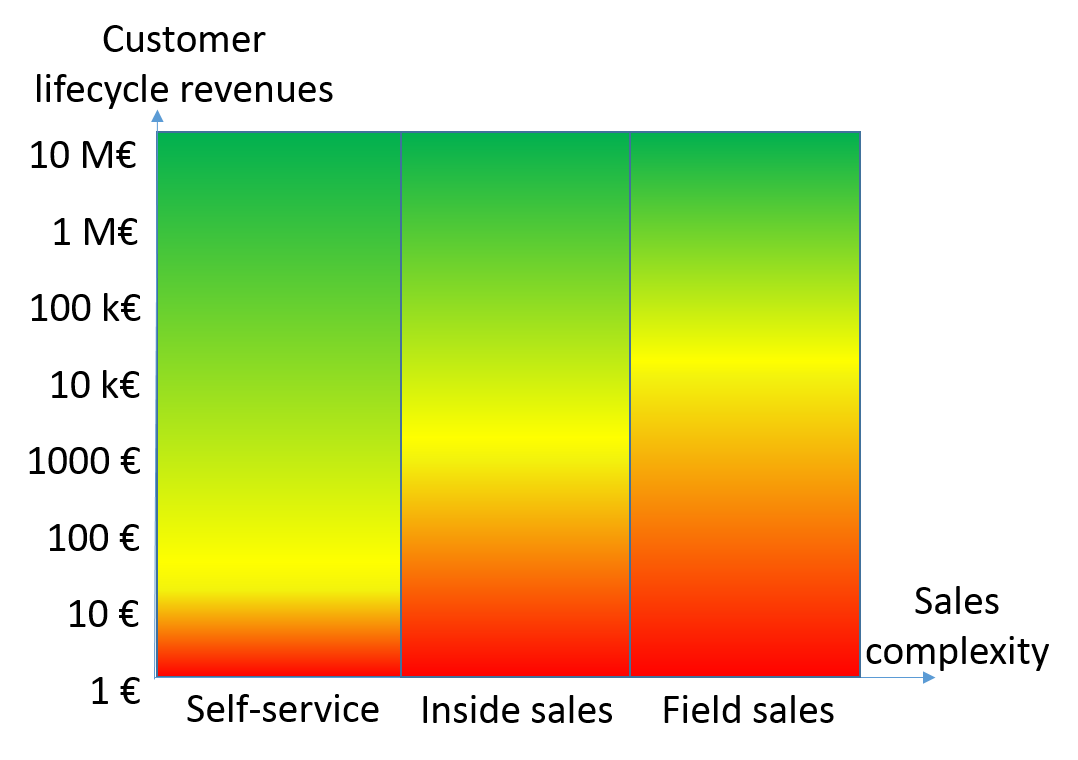
Organising and expansion of sales activities often fail, because it is forgotten that lifetime customer contribution need to exceed customer acquisition costs. And even this is not enough. The total contribution, i.e. total sales margin euros need to cover not only customer acquisition-related costs, but in addition R & D and administrative costs, depreciation, amortisation, interest expenses and income taxes - and, hopefully, there will be some profits left after that.

At sufficient level of accuracy, it is possible to define for each of the three sales methods required minimum customer contribution in euros, see the picture above. In each method, the green area shows acceptable contribution per customer, in the red area operations are not profitable. The line between green and red area is not carved in stone, as illustrated by the yellow zone between green and red areas.

At this stage, many people may raise their hands and say, that the above does not apply in their business, because the revenues are accumulated over a long period, and the first deal is only a spearhead. This is true, total customer contribution must include entire customer relationship lifecycle - in  a similar manner as customer acquisition costs need to cover costs over the entire lifecycle. But in case of business logic, where the profitability of a company is not so important, you may be able to ignore these laws. This often happens, for example, in startups; the idea is to make potential takeover candidates, with different kind of monetisation logic, more interested.

Sales development


In developing its sales activities a company thus has two basic recipes for success: to get more revenues from customers or reduce sales complexity, see the picture on the right. It is possible to get more revenues from customers by bringing more value to their business, by differentiating from competition and by avoiding tough competitive tendering. Although getting more revenues from customers is the ultimate must for sustainable long-term competitiveness, growth and profitability, it will not be discussed on more detail in this post.

By reducing sales complexity it is possible to switch to lower-cost ways to acquire customers; in practise face-to-face selling is replaced with inside selling, and self-service is used instead of inside sales. Some factors, however, make the simplification more challenging, e.g.:
  • Evaluating of the product or service is difficult and it involves a lot of buyer's representatives
  • The product or service is of vital importance; for example, if the selected product does not work, it may result in major economic or health loss
  • The product or service is expensive, requires major changes in buying company practises or other systems
  • The specification or contract of the product or service to be delivered is complex
If a company does not constantly seek to simplify its sales, it is not able to take advantage of the entire sales potential and it faces a serious threat to be outpaced by competitors. There are, however, a number of ways how companies willing to grow and renew can aim for a better market position through simplification:
  • Building easiness to sell in product or service already in development phase: for example, by implementing product configuration so that it is supporting customers' processes
  • Creating a business model that makes selling easier: for example, free or very low-cost pilots, or more cost-effective execution of field sales through channel partners
  • Improvement of sales and marketing machinery: e.g. aggressively using digital marketing methods and tools for demand creation, utilisation of self-service and inside selling for deal-making, whenever possible
Utilisation of various selling methods and tools is not a simple yes / no decision. In practise, you should consider using the available options by product or service, by various stages of sales process, by market segment or as an internationalisation tool. For example, when one of my cooperation partners made a transition from using field sales to self-service enriched by light inside sales, it was able to target also SMEs, besides earlier served major corporation accounts. Similarly, mental barriers to internationalise have several times been decreased by making the first steps through inside sales, instead of building immediately own local presence.

Conclusions


Many companies and industries have already taken the path of continuous sales renewal, at the forefront are ICT and such successful companies as Oracle. Also, necessary tools for change and successful references can be found in plenty. For example, for B2B inside sales, both dedicated service platforms for building own operations and special companies offering inside sales as a service are available.

Because you've got this far, you might want to get better sales results. Do you find answers to your specific business situation by renewing your sales strategies or sales models, or do you have challenges with your sales process?

23 February 2015

Try to avoid competitive tendering

In business to business (B2B) trade companies are looking for - and, in most cases are also achieving - undeniable advantages through competitive tendering. It makes it possible to systematically choose suppliers, get information about the options available in the market, evaluate supplier candidates' ability to understand client's requirements and make estimates of potential cooperation fluency. And the icing on the cake, competitive tendering also provides a quite reliable picture of the value of various options in relation to their price.

But ill-advised and performed tendering can be detrimental not only to the buyer and the selling company, but also to our entire economy.

Buyers or sellers do not need to powerlessly follow the challenges of competitive tendering world - with the right strategies it is even possible to improve competitiveness of a firm.

Buyer shall not get renewal impulses


Narrow-minded tendering easily solidifies buyer's development activities to focus on marginal product improvements and extensions. Instead of keeping eyes and ears open for new external ideas and solutions to make bolder innovation leaps, strict requirement definitions reduce the role of supplier partners as an implementer of buyer´s prevailing worldview.

A system integrator, for example, believed to know the future software needs so well that the implementation of major components could be effectively outsourced through competitive tendering. As a result, hourly charges of acquired work fell, but on the other hand, the life-cycle cost savings were not achieved. At the same time, the existing vendor partnerships, producing continuously new insights and innovations, were destroyed, affecting negatively company's competitiveness.

In particular in Finland, there is a pressing need for cooperation with supplier companies, instead of the rigid tendering principles. According to a research paper, companies in the country rely too heavily on internal know how and resources in generating new product ideas. Similarly, the companies invest more lazily than their international benchmarks in projects, which generate new businesses or entirely new, genuine innovations. And since customer experience improvement and customer engagement often occur with new business models, achieving higher margins often remains a dream.


Seller's growth and profitability challenges


In principle, competitive tendering gives a selling company an equal footing to compete with other sellers, and in general, competition makes tougher and stronger. The problem is that participation in competitive tendering is shaping a company in a way, that makes opportunities for profitable growth narrower and narrower:
  • Detailed definition of the solution to be acquired, to make a comparison of the proposals easy, leads to price emphasis on the selection criteria
  • For sellers, this means, in addition to thinning margins, also collapsing opportunities to stand out from the competition through innovation
  • In the longer term, the development of competitiveness thus focuses on marginal product improvements, increasing operational efficiency and continuous cost-hunt 
The company gets stuck, therefore, in the vicious cycle of competitive tendering, see the picture below.


Vicious cycle of competitive tendering will destroy company growth and profitability. 

There are many companies in this vicious cycle, just now, small to large. A story of a component supplier, based on my own experiences, is illustrative: Customers complained about the prices and through competitive tendering compared them and the characteristics of our products with those of the competitors. As a result, we focused on adding new features to our products based on customer requirements. The competitors did the same, so customers did not see big differences in the solutions, and prices came under increasing pressure. We had to shave our cost structures. The story did not have a happy end...

Boost for the economy and companies


The vitality of Finland's economy and its enterprises is dependent on the diversity, dynamism and innovation capabilities of the ecosystem. One of the main drivers are new products, services and business models. But this is not enough, innovations also need customers. Especially for SMEs and startups it may be difficult to acquire far-away reference customers. And if you can not find nearby customers, who have the courage to look over the tendering practices to new innovations, you are missing another important growth driver. 

But there are a lot of things that can be done to improve the situation:
  • Buyers can enhance the role of suppliers from being a mere implementer to becoming a true, active innovation partner
  • Sellers can, through their own actions, affect buyers´ views before decisions on competitive tendering have been made, thereby increasing the weight of their own strengths in purchasing decisions - or thus even been able to completely avoid competitive tendering
  • With targeted public incentives and measures in place in our domestic markets, there is a possibility to create more willingness to acquire and deploy innovations.

16 October 2014

Find the most compelling export countries

One of the best ways to stimulate growth is successful market entry to new, international markets. But first you need to identify the most compelling markets - and these decisions are better to be based on the facts. I have also in my own career come across with internationalisation cases, where the key motivations were, for example, the language and cultural knowledge of decision-makers, coincidences or emerging romances.  It is of course possible to be successful just by counting on luck, but a more systematic approach will probably produce better results.

Here we shall go through methods to identify the most lucrative markets, introduce a tool for Finnish companies to facilitate the first steps of the job and walk you through an example of the use of the tool. The methods are suitable not only for international market expansion, but also when evaluating country priorities in new product, service or business model commercialisation.

Methods to identify the most compelling markets


Both company internationalisation researchers and experts of the sector appear to have broad consensus on the priority-setting and choice of international markets:
  • First, select the markets worth taking a closer look, based on macro-economic variables of the markets
  • Secondly, study the market potential for company's products in selected countries, and 
  • Thirdly, estimate the sales potential of company's products in relation to required  investments
The main factors affecting the market selection are thus:
  • Company related: e.g. the type of product or service, management characteristics, the size of the company, or experience in internationalisation issues
  • Target market related: e.g. the attractiveness of the country or market, marketing infrastructures or competition
  • Target market entry barrier related: e.g. country risk, customs and other barriers or physical and psychic distance
According to the model set out above, the made plans are indeed systematic but also mechanistic. They often lead to substantial investments, without the possibility, if necessary, to change the plans.

Of course, these things can be studied by means of desk studies, but a more in-depth view can only be found by having closer contacts with customers and markets. Traditionally, the tool has been own or outsourced market research, but its disadvantage is significant time, money and resources required. Globalisation of consumption and purchasing decisions, along with online methods, has created new, more cost-effective methods; international market selection can be made more iterative, avoiding too early choices that can easily lead to waste of resources.


Internationalisation Heat Map


Internationalisation Heat Map was developed as a tool for Finnish companies to easily and rapidly evaluate the attractiveness of entering various European markets. The tool encompasses all the European countries with the exception of mini countries, as well as some of the Balkan and Eastern European countries, where no reliable information is available.

Six elements were selected as the key factors of the Heat Map, with a user giving weight to each of them:
  1. Market size: measured by the population of a country 
  2. Purchasing power of the market: the measure is country's gross domestic product (GDP) per capita
  3. Ease of doing business in a country: measured using a World Bank comparative study on barriers and incentives of doing business in different countries
  4. Market openness: measured by using a comparative study by the International Chamber of Commerce on international trade openness in different countries
  5. Physical distance from Finland: measured using distances of country capitals from Helsinki, Finland
  6. Psychic distance from Finland: there are numerous, complex formulae developed to evaluate this, but here we use a good approximation of country's total trade (exports + imports) with Finland
The tool is used so that a user will assess the significance of each of the factors 1 to 6 from his or her business and internationalisation point of view, giving each factor a number value between 0 and 100. If the number is zero, then the factor is not taken into account in assessing the attractiveness of the country. Similarly, the number one hundred means that the factor is extremely important. Each factor should be evaluated individually, but a user gives each factor a weight based on what is important in company business. Each country gets an end result between zero and one hundred: the higher it is, the more lucrative the country is for market entry.

An example of Internationalisation Heat Map use


As an example, the tool is applied to analyse internationalisation plans of Ludus Helsinki. I was heavily involved in the business operations of the consumer product company aiming for rapid international expansion. Its products inspired children and young people to move, using a gaming-based service concept consisting of the Internet, software and dedicated devices.

 The most important factors of Ludus Helsinki internationalisation plans were market's purchasing power, ease of doing business in the country and country's psychic distance from Finland. The basic reasons behind this were
the facts that the product was quite expensive compared with its benchmarks and that it required a specific distribution and retail infrastructure. The size of the market and its openness were also important, but distance from Finland was not considered to be a very vital factor. The weighting of the various internationalisation factors is illustrated in the picture above.

The factor weighting produced the results of the chart on the right side. The most interesting export destinations seemed to be Germany, Sweden, Norway, Russia, the United Kingdom, the Netherlands and Denmark. The only surprise was Russia ending up so high. The importance of Russia, however, decreased significantly, when other important points for the Ludus Helsinki business were taken into account:
  • Tablet and Smartphone penetration in the country
  • The importance of non-competing physical activity for children and young people in the country
  • Sophistication of using digital marketing methods and tools in the country
The results were also very consistent with the conclusions of Ludus Helsinki digital marketing efforts: highly ranked countries generated more customer interest and the distributors and retailers in these countries were also the keenest to start to sell the product.

The used tool can be found here. 

5 October 2014

Growth financing for Finnish SMB companies

Lately I have been contacted by several SMB entrepreneurs for bank loan challenges. Indeed, access to finance is a key obstacle to the growth of many Finnish small and medium-sized enterprises. If you do not have deep enough pockets, or, for one reason or another, you do not want to rely solely on bank financing, you might want to look into what kinds of instruments public sector and private investors are able to provide. Bank financing, services offered by insurance companies or bonds for SMB companies with the First North provided marketplace, are not discussed here. If a company is in a startup phase or finds crowdfunding opportunities attractive, other potential funding sources are listed here.

The focus is on company growth and, in particular, organic growth. Thus we are concentrating on situations, where a company aims to increase its product or service sales on existing markets, to grow revenues through international expansion, or to create more turnover by developing and bringing to market new products, services or business models. Growth paths that, for example, utilise acquisitions, ownership or industrial arrangements, are not discussed here.

Financing sales growth


Growing sales require financing for e.g. manufacturing and service delivery capacity, working capital or for marketing and sales machinery. On the other hand, significant new investments in product development are usually not required. From funding point of view, just boosting sales is, therefore, often not so sexy compared with internationalisation or innovation initiatives. This is not, of course, how it should be; if a company cannot reach its revenue potential with current products on its current markets, it will also fail with new products or on new markets. A good and credible plan on how to use the new funding and how it affects enterprise value, makes it considerably easier to secure financing.

Company development grants by ELY centres are the basic public sector tool for financing sales growth. A grant may be used for investments, e.g. in land, buildings, machinery, equipment and furniture. In addition, it may also be used to finance development activities, for example, to hire external experts to develop company's strategy or sales and marketing. A small business may also apply for a grant for wage and salary expenditures required to create new jobs or for other expenditures relating to expanding business.

European Regional Development Fund (ERDF) is running a programme that improves competitiveness of SMBs, granting funds for business development and job creation. ERDF also partially finances the company development grants of ELY centres.

Finnvera may participate in the financing of investments and working capital with loans or guarantees. Depending on the amount of the grant requested, Finnvera can either be the sole financier, or funding requires co-financiers, or sufficient amount of the total financing must come from the company itself.

Private investors like Bocap, Korona, Fenno Management, MB Rahastot and Noweco Partners are among the ones that offer equity, loans or other financing to grow company revenues. Besides credibility of the business plan, many funding players have preconditions for the size of the funded company, as well as for investment size and industry focus. Garantia is, in turn, guarantee insurance company that guarantees funding and other liabilities of Finnish companies, as well as insures risks associated with investments.


Financing internationalisation

International market expansion gets a lot of interest and attracts potential public and private financiers.

Company development grants of ELY centres and SMB competitiveness development programs of ERDF can be also used for internationalisation.

Finnvera loans and guarantees can be used to cover the need for working capital arising from exports or to finance the international operations of a Finnish parent company. Export guarantees, export credit and interest equalisation services protect companies against the risks associated with export customers, banks and countries and help in the funding of export projects. Equity investments can be made together with private entities in technology-intensive or innovative service enterprises that have the potential for developing into international growth enterprises.

Suomen Teollisuussijoitus (Finnish Industry Investment) makes, together with other investors, own capital based investments to companies going international. Investments can be equity, capital loan, convertible bonds or mezzanine financing.

Tekes supports planning for global growth; it gives grants, for example, to test a new concept or product to potential clients, to develop marketing strategy and to make studies on intellectual property rights and their protection. Applicable until the end of 2014, Tekes Team Finland Explorer program gives loans to purchase professional services for e.g. target market expansion studies or new market business plans. Under Young Innovative Enterprises (NIY) business development framework, it is also possible to obtain a grant or a loan for internationalisation.

Finnfund finance companies that operate or plan to operate in developing countries or in Russia: the instruments are equity, investment loans, mezzanine financing or their combinations, as well as in exceptional cases, guarantees. Business partnership support by Finnpartnership includes grants for establishing operations in developing countries, which can be used in project planning, development and training phases.

In practise most of the private financiers require that a company is engaged in and is seeking to expand international business. For example, Conor Venture Partners, Folmer Management, Helmet Business Mentors, Innovestor and Tutor Invest underline their willingness to finance companies going international. Besides industry and size preferences, investors have - depending on their background - varying preferences on internationalisation directions.

Financing innovation and commercialisation


Tekes has traditionally been the cornerstone of developing new things: its research and development funding provides grants and loans for developing products, services, production methods, business models and competence. A mere development project does not, however, create company growth, and Tekes has rightly been criticised for supporting only technology exercises. For this reason, it is now offering also loans for demos, piloting and commercialisation, which can be used for, inter alia, machinery and equipment rent or depreciation, materials or supplies costs and for other commercialisation costs. Commercialisation costs can be also covered by NIY funding.

Company development grants of ELY centres can be used, for example, for patent rights of technology transfer initiatives, licenses, know-how or acquisition of unpatented technical knowledge. ELY can also cover raw material and semi-finished product costs related to product development, as well as salary and wage expenditures. In addition, also ERDF supports creation of new business activities in small and medium-sized enterprises.

EU Horizon 2020´s SME Instrument supports growth-oriented, innovative small and medium-sized enterprises. The program assists in the development of new concepts and solutions, in testing and commercialisation. The programme has identified certain priority areas, such as ICT, biotechnology and sustainable energy and transport.

Private investors are more interested in the results of innovation and commercialisation than just doing something new. Most of the investors, however, do appreciate new approaches and consider well functioning innovation and commercialisation machine as a precondition for funding. For example, Auratum, Folmer Management, GTW Group, Joy Group, Nordic Growth and Vision Plus emphasise the importance of innovation.


More information on Finnish SMB funding


All of the above mentioned financial instruments and sources require an application and negotiation process, with always uncertain end results. By pinpointing the right potential funding sources that have strategies matching with the business situation and objectives of the company, and by running the application process professionally, the odds of success can be significantly improved.

More information on the sources of funding for small and medium-sized Finnish enterprises can be found on the webpages of financiers and by contacting them directly. There is also a summary of financing sources available with more information on general conditions of funding, as well as on possible company and industry focus.

24 September 2014

More growth with marketing automation

Finnish small and medium-sized businesses have been slow to take advantage of marketing automation. The seriousness of the situation will become clearer when we notice that a company's growth and profitability strongly correlate with the use of the new digital methods and tools. The technology itself is not the solution, but as a part of systematic renewal, it will help the company to stand out from its competitors. This blog will discuss the benefits and utilisation of marketing automation, especially from business-to-business (B2B) SMEs point of view.

Why marketing automation?


B2B companies, small and large ones, are facing the disruption brought by digital channels: since customers´ purchase processes more and more rely on web based information, ignoring traditional discussions with sales persons, it's much harder than before to reach them at the right time and with the right messages. In addition, customers have adopted global approach, they are looking for products and services well beyond domestic markets.
This will make room for marketing automation. It enables companies to get better visibility on what buyers really like and how they behave; thus it will be possible to boost the implementation of growth strategies, to increase sales by improving market share, to facilitate expansion to new international markets, to support the development of new products and business models or to enhance go-to-market programs and processes.

How marketing automation creates growth?


An American study found that 63% of the companies that are using marketing automation, grow faster than their competitors. Another research revealed that 79% of the top performers have utilised it for over 2 years. A study on Finnish B2B SMEs gave similar kind of results. Next chapters discuss in more detail how marketing automation supports some key growth strategy components.

Sales growth

Marketing automation increases sales, inter alia, through the following mechanisms:
  • The results of marketing campaigns can be accurately tracked and thus campaign effectiveness is better: it is possible to get more results for the same money or the same results for less money. 
  • The number and quality of customer leads grow: there will be more closed deals. 
  • Business relationships with customers will get tighter and it is possible to identify changes in customer behaviour and needs: cross-selling and upselling opportunities with existing customers can be realised. 
  • Sales and marketing cooperation intensifies: sales persons also market products and marketing persons also sell products. 
There is plenty of backing for the above. For example, a Forrester research found that B2B companies utilising marketing automation get considerably better results in their marketing campaigns and also their sales and marketing functions have much tighter cooperation.


International expansion
When expanding business into new market areas, marketing automation can ease the process, for example, in the following ways:
  • It is possible to reliably assess already in the early stages of internationalisation planning, whether potential target country customers and distribution channels are really interested in the company's products: target country prioritisation and selection can be done faster, with lower costs, and the risks with selected alternatives are smaller. 
  • Even before the business is launched, it is possible to get good insights on the needs and purchase processes of potential target country customers: necessary changes to offerings, as well as to marketing and sales channel processes can be done in a timely manner. 
To support this, a study on Finnish B2B SMEs revealed that digital marketing maturity clearly correlates with the relative size of international operations.

Support development of new products and business models

Marketing automation will bring more insights to new product and business model innovation and decrease uncertainties related to it. The corresponding mechanisms include e.g.:
  • At an early stage, it is possible to obtain customer feedback, whether there is enough demand for a planned product or business model: return on investment of the development projects is higher, because they can either be stopped in time or the changes appreciated by customers can be built in. 
  • It is possible to see at a sufficiently early stage, what customers need in order to take a product or business model into use and to then use it actively: expanding the core product with customer valued extensions, either by the company itself or with partners, will bring greater yields. 
The agile new development model has brought good results in the domain of digital services and startups and now it is rapidly spreading also to more traditional sectors.

Enhance go-to-market

Go-to-market of products or business models can be enhanced with marketing automation e.g. through the following ways:
  • By finding the right ways to generate customer attention and interest, as well as by identifying the most suitable sales channels to customers: quantitatively and qualitatively enough customer leads, which results to more closed deals. 
  • It is possible to find early enough marketing messages that resonate with customers and a positioning that stands out in the market: company products will get attention in the marketplace and the importance of price in purchase decisions will be reduced. 
  • Marketing and sales functions cooperate effectively and aim at the same goals: sales revenues can be maximised.

What companies should do?


Utilisation of marketing automation is already in full speed also in European companies. The pioneers are technology, financial services, life sciences and energy, followed by, for example, telecommunications, manufacturing and professional services. In Finland, for example, the following small and medium-sized B2B companies are leading: Basware, Vaisala, Deltek, Metos, CRF Box, Nebula, Asiakastieto, Zeeland and SSH.

The starting point for efficient exploitation of marketing automation is the definition of company strategy for the renewal and growth; in other words, from which direction, by what means and resources, the company is trying to find a new way to prosper. Overlapping with this are company personnel and development of their knowledge, skills and attitudes, as well as implementation of processes, required by the new strategy. Only then it is the time for marketing automation as the technology and the solution, which enables and glues together the strategy, the people and their competences, and the processes.

When selecting a solution, the key is the vendor's ability to support the company's business; the key parameters include, for example, solution features, customer segments that a vendor is targeting, possible industry focus and pricing models. All these are compared in a review, which also lists Finnish company references that the key marketing automation vendors have.

21 May 2014

Digital marketing maturity equals success - case Finnish B2B SMEs

Small and medium-sized enterprises (SMEs) are suggested to have a significant role in the revitalisation of the Finnish economy. Their current actual business performance is, however, not as good as expected. Therefore, it is necessary to look more closely at how companies´ own actions affect on their success. This post shows that based on a study, Finnish B2B SMEs do not effectively utilise digital methods and tools in their customer interface. It also finds that digital marketing maturity strongly correlates with success.

Changes in B2B business environment 


Competition in B2B markets is global, products and services are searched, compared and procured across the borders. Vendors have been forced to follow their customers, very few B2B companies can rely on domestic customers only. Local markets that used to be isolated with their own specific terms and conditions, are also changing: the same technologies, standards and processes are in place everywhere, making it easier to demonstrate and offer products by means of inside sales and marketing. Internationalisation also creates brutal cost pressure on all business operations.

Face-to-face meetings have traditionally played a central role in B2B sales. But today, customers are ready to meet sellers very late. According to a survey, on average, as much as 57% of customers´ purchase process is already over, before they are willing to meet with vendors. To win customer orders, vendor companies need thus to be able to present their offerings, references and other competitive advantages before the first sales appointment.

At the heart of the change is the Internet. It has become the first source of information for B2B buyers. And besides information search, the Internet significantly affects on all purchasing process stages. B2B company website and presence in social media are vital and indispensable anchors of Internet influence. The companies looking for information and solutions are then reached utilising inbound marketing techniques. Digital interaction with customers generates huge amount of data. Its utilisation will not only help to develop more competitive products, but also enables ever evolving customer operations. It is verified that B2B companies that effectively use digital methods and tools in their customer interface, are doing significantly better in acquiring customer leads, nurturing leads to paying customers and retaining their existing clients.

Besides evaluating overall digital marketing effectiveness, utilisation of real-time and predictive analytics as well as marketing automation are good yardsticks when estimating digital marketing maturity.

Real-time analytics (e.g. Google Analytics and Coremetrics) can be used, for instance, to follow how visitors will find company website and how they interact with it. This will improve, among other things, customer acquisition cost-effectiveness and understanding of clients' needs and priorities. In addition, it will sharpen marketing communications more relevant. Marketing Automation (for example Marketo and Pardot/Salesforce) automates communications and maintains customer interest in the marketer firm. It makes it possible to serve customers with higher quality and more cost-effectively – and thus get more sales. Studies show that B2B companies, utilising marketing automation, get more and higher-quality customer leads and grow faster than their competitors. Predictive analytics (e.g. Totango and Kissmetrics) with sensor-based customer listening capabilities can identify e.g. customers at risk of churn or intensify cross-selling and upselling.

Status of SMEs in Finland


Then, let us look at how digital tools and methods are used in Finland. A Finnish trade magazine, Kauppalehti,
database was used to pick randomly 108 B2B companies whose turnover is between 10 and 200 M€. Almost all the major industries were represented. Some, e.g. consulting, and construction were excluded, though the analysis is highly relevant to them, too. The selected companies are the best among their peers, so the general situation is hardly better.

To get an overview of digital marketing effectiveness, the companies were examined with algorithm based automatic tool, see also the box on the right. The results obtained can not in any way be regarded as an absolute truth, but anyway, the tool is accurate enough to analyse the situation.


We should be very concerned. The best Finnish B2B SMEs are below average in digital marketing, and almost every fifth of them are even rated bad, see the graph on the left. Only about 5% of the companies are good or excellent.

The situation by industry is uniformly poor, only software companies stand out better, see the graph below.

To get a domestic benchmark for the results, also the biggest B2B companies in Finland were examined (Finland top 20 in the graph). These enterprises are considerably


more advanced, even surpassing the software company results. Because there is a clear indication that the Finnish big ones are not at the utmost forefront of the global development, the SMEs sector is subject to a resounding wake-up call.

Next we examined the use of real-time analytics (by using an automated tool, see also the box above). More than one fifth of the surveyed SMEs do not take an advantage of it. It means that they in practise wander around in the dark, not understanding outcomes and shortcomings of their digital world activities. In the control group, on the other hand, all big companies in Finland are using the analytics. The most commonly used analytics solution, by the way, is Google Analytics that is free to use. US companies are a great international benchmark for the Finnish findings. There the big companies and also the SME sector seem to have faster adopted the use of analytics in their business operations than their Finnish counterparts.

Only 5.6 % of the selected Finnish small and medium-sized companies take advantage of marketing automation. There are no major differences across various industries, few pioneers are emerging in almost all sectors. Every fourth of the Finnish big corporation benchmarks are utilising automation. In the United States, it is estimated that 25 to 60 % of large B2B enterprises use marketing automation. Correspondingly, studies show that the penetration in US small and medium-sized enterprises is at least 10 to 25%. High-technology sectors, followed by consulting and manufacturing industries, are leading the pack in the United States.

None of the studied Finnish companies, neither large companies nor SMEs, used predictive analytics. Because of international examples, it is expected that those companies that have digital service elements in their offering will take the lead in adoption.

Lastly, we studied how digital awareness affects business performance. Business growth, profit, return on capital, as well as the size of international operations were picked up from the Kauppalehti database. The companies under investigation were divided into two categories, based on whether they are rated to be in the top half in digital marketing  (> 50) or in the bottom (< 50), see the graph below. The conclusions are very clear: on average the digitally-leading companies are growing faster and their profitability is better than those of their lagging counterparts. In addition, the international operations' share of net sales was clearly correlated to the digital marketing maturity.


Conclusions


On average, even the best Finnish SMEs are not taking care of their digital marketing very well or even satisfactorily. This is reflected in comparisons with large Finnish enterprises as well as relative to international benchmarks. And because utilisation of digital methods and tools is a key lever to achieve business success, we are facing a similar kind of problem as the whole Finnish economy: though business premises are good, the SMEs are capable of delivering significantly less than available potential. As an outcome, a company might face e.g.:
The situation, however, can be improved. Change is in the hands of small and medium-sized enterprises: they need to re-tool their strategies, processes and competencies to embrace new methods and tools in customer-facing operations - and then implement technologies that are supporting the new approach.

21 February 2014

Internationalisation - a solution to get your troubles far away?

Internationalisation is often seen as a trick that drives company's troubles away. This is not the case, however. For example, if the choice of the first target countries, finding channel partners or optimum location for your own sales office are initially the key issues, essential homework has not been done. Then you need a lucky break. And although you need luck in the business world, you must make every effort to try to improve your odds.

A structured approach to internationalisation is connected to the company's objectives, strategy, competences and resources. In this case, it is not a question of tricks, but of evaluation, if it makes sense – and in what way - to aim for international markets. This post tackles the following core questions of internationalisation:
  • Why to enter new international markets?
  • Which are the key issues when planning internationalisation?
  • How to build internationalisation in a systematic way?
These questions are relevant, regardless of whether a company is small or large, whether it is already making business in some foreign countries or is purely a domestic market or startup business. The post focuses on issues that are directly linked to revenue-generating market operations. Thus, for example, manufacturing or R&D resource driven foreign operations are not discussed here.

Why international markets


In most cases market expansion is driven by the reasons related to objectives or a business idea of a company, its products or customer relationships.

Probably the most common reason for internationalisation is the desire to grow. It might be too difficult to increase market share in the currently served markets, or extension of the product range is not considered lucrative enough. Operating across borders can also be a basic premise for the business; for example, many startups coming from smaller countries find their domestic markets far too small to support a profitable business.

Especially growth companies seek to aggressively increase the value of the company: e.g. to improve access to financing or to have better financing terms. Bigger potential markets and initial success in these markets will significantly raise the value of the company and its prestige among important stakeholders.

The most advanced and demanding customers greatly assist in creation of such product functionalities, which also a wider market and laggards will find useful later. So, for example, Swedish car manufacturers were for a long time deemed the pioneers in the area of security, so cooperating with them was good for success also elsewhere. Today, Germans are leaders in many vehicle technologies, so the market pulls keen supplier companies.

Many businesses have found that they cannot find customers for their products on the domestic market. The reason may be would-be customers´ lack of courage to adopt new solutions or business models enabled by them, or simply conservatism of an industry and its players. For example, a Finnish machinery component supplier, Visedo, were forced to seek first clients in Germany, Austria and France, because domestic players were not forward-looking enough to take the new solution.

Key issues in internationalisation planning


By identifying the business drivers of internationalisation, we can also evaluate globalisation activities conducted so far. They may turn out to be either a great platform to scale the business considerably or it might be best to forget them, because their value is null and void, or they would put the company in the wrong direction.

After this, we will look at how company business idea and strategy affect on global expansion. In a similar manner, we will study in more detail company's products and total offering to customers, its differentiation strategies on the market as well as its customer-facing strategies. This will be used to create an overview of the capabilities and resource gaps that need to be overcome before one can expect success in the new markets. 

Business concept and strategy


A company's business idea defines the target customers, its offering and how the offerings are produced and made available for customers' use. If a company is customer-centric, its target segments and their needs also strongly influence offering properties. When globalising the key is to understand how well the new market customer segments and their needs correspond to the ones in the existing market. Many companies, however, have a technology or product based strategy. This emphasis the need to find in the new markets customer segments and customers that find company technology or product features compelling and value generating.

As a result, any plans to internationalise raise the following questions:
  • Is the business model in today's market well-tested and can it be replicated to new, international markets?
  • Is there willingness and ability to change the current model and how much?
Most of the incumbent companies will end up on the fact that the way of working of the home market cannot and should not be directly copied into new markets. On the other hand, if the business is created global from scratch, as in the case of, e.g. cloud service or application startups, the biggest challenges will again be product, differentiation and customer interface related ones.

Product


Absolute requirements of the market, customer preferences and total offering required by customers are the key product related dimensions. The Internet and social media tools have brought tremendous agility and cost efficiency to the understanding of these issues.

The absolute requirements are usually easy to understand and find out. They include local government approvals and other compulsory localisations. The latter include, inter alia, translations of marketing and user documentation and support of local standards or practises. For example accounting programs require support of local regulations.

More challenging is to evaluate new customer preferences in target countries and their influence on product properties. Of course, there are self-evident things, such as the need to adapt sizing of clothing company collections when moving from Northern Europe to Southern Europe or South East Asia. When we move from technical characteristics to emotional likes and dislikes, local preferences start to dominate. For example, a children's outdoor clothing manufacturer, Reima, has discovered that in Russia, consumers prefer different colours in children´s winter clothes compared to Finland. Increasing global uniformity of values, practises and consumption have created very homologous, international segments - in these cases the need for local preference modifications is small. E.g. many Internet consumer service companies take advantage of this.

Also in new markets, customers usually expect to have a total solution. In many cases, it may significantly differ from the one in established markets. When complementing products or services require external partners, availability and access to them in target markets should be separately assessed.

Differentiation


It is important to be different from competitors, because without it, a company needs to typically compete on price. And because most of the competitors have the same customer value-adding product features, differentiation based on artificially created new product features will succeed rarely. Unless there is something new in the product or business model that clients really appreciate, the solution is to look at a company and product image - which again puts emphasis on company's positioning and branding.

Differentiation formulae of the domestic market is not necessarily transferable to the new target countries. For example, a clothing and textile design house, Marimekko, have a strong brand in Finland supported by a long history, distinctive, locally-luminous leading figures and unique collections with locally well-known designers. When company activities have become more globalised, it has been noted that the domestic brand concept is not necessarily bringing success in other markets.

It is essential to understand that a company and its products do not have to be widely known in the new market, as long as it is well-known in the target customer groups. Who, for example, knows Wärtsilä and its ship engines, if one is not belonging to their target customer groups? In addition to being able to create awareness of the product, it is important that the company's products have a reasonably good reputation and that the target customers are hungry for these products. When we go into a new market, a company usually starts from scratch: it is not known and the clients do not have a special longing for its products - on the other hand, it still has a very neutral reputation. It is worth considering how much, for example, current market references, globalised sourcing decisions and consumption habits, as well as international operations of existing clients could help in the development of the brand. And it is always possible to re-position the company completely, at least in the international markets.

Customer acquisition and retention


Although business idea and strategy, products and total offering as well as differentiation in the new markets would be okay, no success will come without being able to acquire and retain customers. Looking this another way: even the best systems, people and partnerships for demand creation, deal closing and customer loyalty do not bring results, if the previously discussed basics are not in good shape.

The essential steps of the customer relationship cycle include creating awareness among potential customers, building interest and willingness to buy, deal closing and customer retention. If a company is capable of differentiating itself in the market, it is already a good start. A model that has been developed and tested in the domestic markets and that is capable of generating enough demand and revenues, is a good basis for developing activities in the new markets, too.

The key is to understand to what extent the established market practises are suitable for the new markets: which of them can be utilised and what kind of capabilities and resources the company has to change the existing way of working. For example, use of media advertising, solution sales process renewal or web enabled customer service could be considered as corrective tools.

Entering new markets will be most often done with thin investment and expense structure. Fortunately, different types of Internet and social media based marketing, sales and customer relationship management tools provide cost-effective ways to get ahead. A more traditional approach is to build partnerships based marketing and sales activities: the danger is loosing touch of customers and the market, which, at worst, will soon destroy company's competitiveness.

Systematic internationalisation


After own motives and capabilities in relation to the company´s business objectives have been studied, the decision can be either to go forward or to focus on other business initiatives that are more lucrative or urgent.

If it is decided to continue, a preliminary assessment of capability and resource gaps in the internationalisation should be made. It is also important to determine whether the gaps should be filled with building the capabilities and resources in-house or whether partnerships would be the solution. For example, a company may decide to build sales, marketing and customer service capabilities in the new target countries by itself or it can rely on channel partners.

When still known gaps in the market information have been filled in, a detailed plan for the internationalisation can be made with priorities, timings and budget. At this stage, the target market and channel partner selection issues are already relevant. 

6 February 2014

Go-To-Market: more customer-centric, hungrier and more agile

Turbulent market environment is constantly changing business and competitive conditions. New technologies blur industry boundaries, shorten product life cycles, change business models - and bring new competition through globalisation. In this environment, Go-To-Market (or GTM) success is becoming ever more important - competitive advantages are less and less sustainable; instead of technology and supply factors, demand and customer interface capabilities are becoming increasingly vital.

Today, most companies already have functioning GTM processes. They are useful in commercialising a new product or business model, opening up new markets or even when a new company has been acquired. 

This paper will first introduce GTM process and its benefits. After that some of the pain points will be discussed, and we shall show, how a more customer-centric, hungrier and more agile approach will boost results.

GTM process and its advantages


GTM activities make company's business strategy concrete by delivering its solutions and their value to target clients, see also a simplified picture below. In reality, however, GTM is a process, which covers activities from definition of a product to pricing, distribution, marketing, communications, sales and customer support.


Benefits of a well thought and implemented GTM process include:
  • allocation of resources to the most lucrative business opportunities
  • prevention of organisational silos
  • cooperation between centralised and decentralised activities
  • sharing best practises and learning
Metrics need to be created for GTM processes. The intent is to evaluate product and business profitability. Evaluation of project success already in product development and, respectively, GTM phases, ensures that resources are allocated only for the most lucrative opportunities. GTM thus acts as a tool to develop company's product portfolio.

Secondly, GTM process and project objectives bring together different functions of an organisation, thus inhibiting silos. This will also ensure that all the necessary skills and knowledge is just in time and adequately available. In addition, it is easier to create new practises in domains, which are new or require very different types of knowledge-based inputs. Smoother cooperation between marketing and sales activities is often highlighted as a great example of GTM process benefits.

When a company expands and becomes more globalised, it also needs to grow certain functions on a decentralised basis, in other words, close to customers locally. These include, for example, implementation of marketing and communications, sales and first level customer service. GTM process links centralised operations, such as specifying a product and planning of marketing and communications, seamlessly with distributed ones. Also GTM project objectives, strategies and other guidelines are centrally defined. In addition, prioritisation of regions and countries is usually centrally managed. By centralising selected GTM activities, duplicate work is avoided and local implementation gets adequate support.

GTM also allows for sharing of best practises within a project and between projects. Thus the most successful ways of working of the best individuals and teams become an integral part of the entire company's expertise, which is then available and repeatable from a project to another.

Improvement needs


As such an existing GTM process does not guarantee success. Among other things, drastically changing customer purchasing behaviour, multichannel marketing driven by digitalisation and new business models are forcing GTM models for continuous improvement.

More customer-centric GTM


Company products need to resonate well with customer needs and market demands. Thus increased influence of both consumer and corporate customers in the various stages of purchase process calls for rethinking and adjustments in a way a company approaches market. It is also important to find unique customer segments, whose needs can be met better. To tackle all this, GTM activities need to be built to meet customer relationship objectives and strategies, giving possible internal legacy requirements second priority.

Market studies conducted before product development start do not guarantee that products match with customer needs. Rapidly changing markets require that development activities are closer integrated with customers´ feedback on products. Customer development, which has its roots in the startup world, is playing a growing role to facilitate parallel product development and customer testing. Especially huge progress in the development of Internet and social media tools allows for market testing and possible corrective actions already in the early stages of product development. In a similar way it is possible to figure out target market prioritisation and GTM activities localisation needs.

Hungrier GTM


Overall effectiveness, quality and cycle time can be considered as baseline yardsticks of GTM process. However, this is not enough. Tougher business metrics should also be introduced: lead generation impact, sales increase and evaluation of GTM process on the basis of return on investment (ROI). By focusing on business outcomes, we can get rid of bureaucratic way of working, where checklists dominate over hunting for results.

Digital marketing and sales methods have been at the forefront of bringing measurability. But technologies are not to be seen here as masters but slaves - or enablers at most. The key is to create GTM strategies and processes that focus on right things. Furthermore, we should not forget people, who run the process and who truly need to understand and know how to operate the new fact-based model.

More agile GTM


Although a company would have created the world's best client-centred and business metrics-driven GTM process, it does not insulate the company from changes in the operating environment. These challenges require adaptability, responding by foresight or by further developing own activities. The keywords are continuous improvement and best practise sharing.

Activity and environmental data collection and analysis, as well as test and learn principle are the cornerstones of continuous improvement. Data insights lead us to the real issues and improvement options, which will be verified for operational scaling by testing. This makes it possible to avoid costly mistakes made with non-working or outdated GTM practises, and paves way for better results.